
Strong relationship between local news provision and community cohesion unearthed by new More in Common research - Campaign and Comms Manager Beckie Shuker unpacks the details.
The title of this blog is a quote from Phil, a rugby coach in Northamptonshire and one of the respondents to a recent study conducted by pollster More in Common. The groundbreaking research, commissioned by Local Trust and PINF, reveals evidence of a link that we’ve long suspected - there is a strong relationship between the availability of local news and community cohesion.
Local news, social infrastructure and building community connection – June 2026
The study produced some fascinating findings, the gravest of them that a whopping 50% of people in England feel cut off from society around them. This feeling is strongest in areas facing both high deprivation and a lack of social infrastructure - places that Local Trust has termed doubly disadvantaged neighbourhoods.
Almost as many would like to be more aware of local news in their area, and in areas where local journalism is thriving, people are far more likely to feel connected, to vote, to volunteer and to feel that they belong.
62 per cent of those who aren't connected to their communities are also unaware of local news and issues - this falls to only 27 per cent of those who do feel a sense of belonging to their local community. A sense of belonging in, and awareness of one’s own community, therefore, seem to go hand in hand.
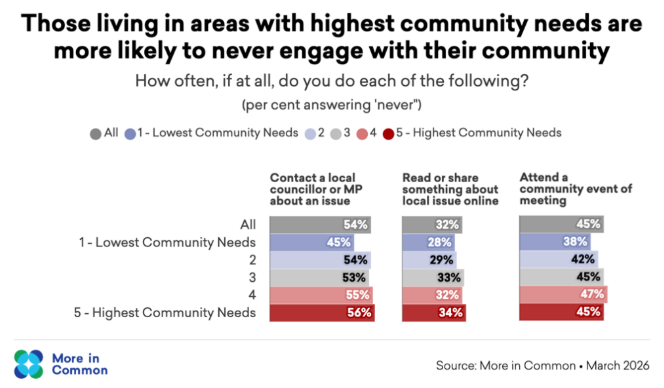
Local news supports people to get involved in their community. Four in ten said they find out about things too late - or miss them completely. With 4.4 million people living in news deserts without access to local information, it’s unsurprising that a lack of journalism comes up as a big barrier.
Many said they need more information about local services, alongside news about decisions being made by local politicians. Without local news, people feel that politics doesn’t work, and they feel pessimistic about their ability to hold the powerful to account. Only one in three of those in news deserts say: “if a local councillor was doing something wrong, I think residents would find out and be able to do something about it”.
On the flip side, where local news is thriving, people are more likely to go out and vote. Half of people on average say they would often vote in local elections, with this figure rising to 80 per cent of people who are aware of the news in their area.
Similarly, only 10 per cent of people in England say they would often volunteer at a local organisation, but this rises to 31 per cent of those who are the most aware of their local news and information.
“With a lot of AI stuff that’s now on social media, I definitely look at a lot less stuff than I used to because I just dunno what’s real, what to believe and what’s not” – Abigail, Respiratory Nurse, North Northamptonshire.
So where are people getting their information where there’s no local news? Those who feel the most disconnected are more reliant on social media for news – but this relationship is changing. Across England, many people are logging off due to frustrations with negativity and conflict on sites like Facebook.
The result is that many people are no longer sure where to go for trusted sources of information, thereby losing access to almost all local information in the process.
“The truth of the story probably could be wheeled out with a really good local journalist, somebody who’s really on site and in tune with the local area and has the contacts to be able to make the story.” – David, Retired, West Kent.
The good news is that we have the power to regenerate local news for future generations, with green shoots appearing from Belfast to Bristol, Southeast Wales to the Southside of Glasgow. There’s clear demand across the country for more local news that supports residents to get involved in their communities and hold decision-makers to account.
The Government’s recently announced Local Media Action Plan is an important first step towards creating a sustainable future for local news, but longer-term investment is needed to roll-back news deserts. We need the Competition and Markets Authority (CMA) to enforce the Digital Markets, Competition and Consumers Act and force big tech to pay their fair share for the news they use on their platforms.
If you’re looking for a way to support your local outlet – now is a great time to do so: this week, 15th - 21st June, is Indie News Week! Local news events are taking place across the country, from film screenings to meet the editor events. Support your nearest outlet and get involved today.
 Public Interest News Foundation
Written by