Fresh from Greater Govanhill's win at the AMIC International Award for Local Media, and International Journalism Festival in Perugia, Rhiannon J Davies explains why we need to focus on strengthening local journalism now more than ever.
Last week, I attended the International Journalism Festival in Perugia. It’s an incredible event that brings together people from across different parts of the industry to discuss the big challenges of the day, and the future of journalism. It’s inspiring, thought-provoking and exhausting in equal measure.
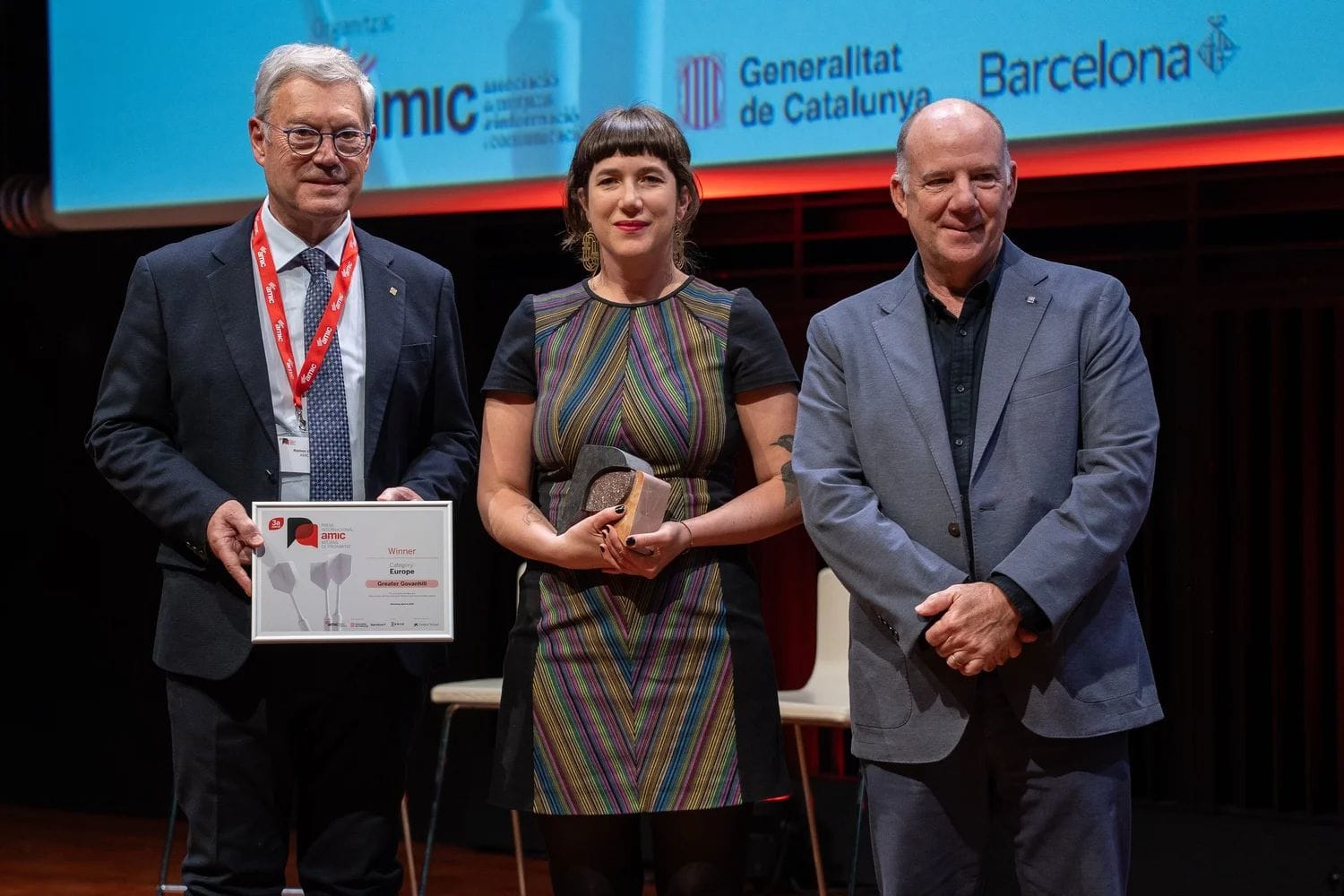
Before travelling to Italy, I was in Barcelona to attend the AMIC International Award for Local Media where Greater Govanhill – a community magazine and media project in Glasgow – won in the European Local Media category. For a project that I set up from my bedroom, while pregnant, working two other jobs, during the pandemic – it was quite surreal to be recognised at this level.
Judges praised our co-creational approach as well as the impact we make within our community with residents and groups often underserved by traditional media foregrounding local voices, social realities, and issues of direct relevance to the neighbourhood, reinforcing representation and visibility.
Being there and talking to other winners and finalists from the US, Colombia, Sweden, and Spain, it was clear that while the contexts were different, a lot of the challenges – and the solutions we’re developing – are the same. It meant a lot to me to see local journalism that responds directly to community needs being recognised and celebrated on an international stage.
So I was disappointed that for the first time in 5 years, the International Journalism Festival didn’t have a dedicated track for local news. And in the nearly 200 official events, only one of them mentioned local news in the title.
Recognising this absence, Correctiv Europe and Journalism Fund Europe organised a side event bringing together stakeholders from across the contingent to discuss strengthening local journalism. I was asked to give some opening remarks sharing personal reflections on the state of local media today – and what it needs to flourish. Here is an edited version of what I said:
From what I see in the UK, I think we’re at a point where the hollowing out of corporate local media – the stripping back, the consolidation, the race to the bottom – is starting to threaten the very idea of what local news is – and has lost people's trust.
And yet, we need local media more than ever. Particularly at a time when parts of the national media are fuelling division and polarisation, usually driven by commercial incentives rather than community need.
Local media has the ability to connect across differences, rather than putting people in one camp or another and accentuating division. When you read local media, you might not agree with your neighbour about a new housing development – but you might agree on the need for cleaner water in your area.
That’s what good local journalism creates: a space for healthy conversations, and democratic dialogue. And I’ve also seen that in so many different contexts in Scotland, through the Scottish Beacon network.
For the past 18 months, with the support of the PINF Tenacious Journalism Awards, we’ve been collaboratively reporting on the impact of the renewables boom on communities – who too often feel like it’s something being done to them, not with them. Our project – The Power Shift – has been exploring how this can be done better.
What we’ve seen doing this work is that when there isn’t trusted local information, a vacuum opens up – and into that comes misinformation, and political actors with their own agendas.
Two weeks ago, we held a launch in Glasgow for The Power Shift magazine and a new network which brought together journalists, researchers, campaigners, and experts to discuss how we could tell better stories on this topic.
And this is what good local journalism does – it connects people, convenes conversations, and builds shared understanding. It’s a vital form of social infrastructure – and a public service. And we should think about funding it in those terms.
At the same time, it also needs to be sustainable – with robust models that are incentivised to respond to what communities actually need, and that give organisations the stability to do this work properly.
Last year I launched a new organisation to help others develop organisations like Greater Govanhill, and grow support for community-centred media. At Greater Community Media, we recently published Funding The Future of Local News – a report led by my co-founder Lucas Batt and commissioned by the Public Interest News Foundation, looking at how local journalism is being supported in different countries.
What we found is a new wave of journalism funds, coalitions of funders coming together around shared strategies, rather than acting alone. They’re designed to avoid reliance on single funders, to bring in larger and more diverse funding, and to provide long-term, and catalytic support. That funding is paired with capacity building – helping newsrooms develop stronger operations, new revenue streams, and more resilient business models.
And importantly, they’re not just backing individual organisations – they’re trying to nurture whole ecosystems of public interest journalism. It’s a more strategic approach to funding – that is starting to show results in different parts of the world, and something I hope will happen in the UK.
I don’t think there’s one answer when it comes to how local news can flourish. But I do think it should be an important part of any conversation on the future of journalism. For me, it’s not about saving local news, or propping up old systems without questioning why they’re broken. Instead, we should be asking ourselves how we build something better – something that responds to what communities actually need.
We’ve seen the impact of that in Glasgow, and through Greater Community Media we are working to help others build local media organisations that truly serve their communities.
Rhiannon J Davies is the founder of Greater Govanhill, a community-centred magazine and media project in Glasgow – which runs out of The Community Newsroom, an open-door space that they opened with investigative journalism co-op, The Ferret. In 2022, she set up The Scottish Beacon – a collaborative network of 25 independent local news publications across Scotland. And recognising the need for more support to build community-centred media outlets, last year she launched Greater Community Media.
Written by