
£6 million is on the table for local news outlets - Campaign Manager Beckie Shuker explains why it's an opportunity we can't afford to miss.
This Tuesday, the Department for Culture, Media and Sport announced that the Amplify Local News Fund is now open for bids. There are two tracks: the fund for local news outlets (LNOF) and the fund for infrastructure (IF) that supports local news outlets.
We'll concentrate on the former in this post: open to local news outlets in England and Wales, there is up to £125,000 per outlet up for grabs. Open to local news outlets in England and Wales, there is up to £125,000 per outlet up for grabs.
With an application deadline of 7th August, there’s no time to waste. PINF has been making the case for a fund like this for years - we want to make sure independent local news providers are able to get their share.
Why does this fund exist and what is it for?
Way back in 2019, the Cairncross Review, on diagnosing market failure in the local news sector, made the case for an Arts Council-style fund for news. The Government of the day said no, and so PINF was born, to keep building the evidence: an Index tracking the sector, a Local News Map and last year the Local News Commission, which recommended a £15 million-a-year, 10-year innovation fund.
The Government may have said no - again - but then this March, Culture Secretary Lisa Nandy announced a Local News Fund of up to £12 million. The grant application states:
"The Local News Fund offers grants through a competitive bidding process to local news outlets and other eligible organisations to help ensure the long-term provision of high-quality local news. The Fund invites bids from eligible providers for grants to invest in innovation and the tools, resources and infrastructure from which the whole industry can benefit in moving towards a financially sustainable future."
In plain terms: this isn't business-as-usual funding for core costs. It's designed to spark innovation that builds towards financial sustainability for local news, including new revenue streams and new tools.
The DCMS are holding a webinar on Wednesday 15th July at 2pm, make sure to register to get more information and ask questions.
Who is eligible?
Here’s our best attempt at a summary:
- Location: based in England or Wales, with a registered office or business address there (Scotland and Northern Ireland are not included this time).
- What you cover: high-quality local news and information for a defined geographical area, encompassing investigative or campaigning journalism, reporting on local public institutions, or other matters of unique interest to communities, such as local businesses, events and community initiatives.
- Track record: you need to have published at least one local story a month for the past 12 months
- Editorial accountability: broadcasters need an Ofcom licence; everyone else needs a named person responsible for publishing decisions, plus a published editorial policy or set of guidelines.
- Structure: you must be a registered organisation. Sole traders aren't eligible on their own — though there may be ways to work around this.
- Registration: you must have been registered, with a published registered office or other business address, for at least a year.
The practical details
- Grant size: up to £125,000 per organisation.
- No minimum: a £5,000 bid is fine. Don't feel you need to go big to be competitive.
- Consortia welcome: you can team up with other publishers on a joint bid, with one lead organisation.
- Payment: in arrears is the default, but if your reserves are less than 25% of the value of the grant you’re bidding for, an accountant’s letter can secure upfront funding.
- Timeline: applications close 7 August 2026 (the scoring framework notes that it could close early if the fund is significantly oversubscribed - we don't know how likely this is, but still - don't delay). Decisions are expected in September. Projects need to start in October and must be complete by 22 March 2027.
How to build a strong bid
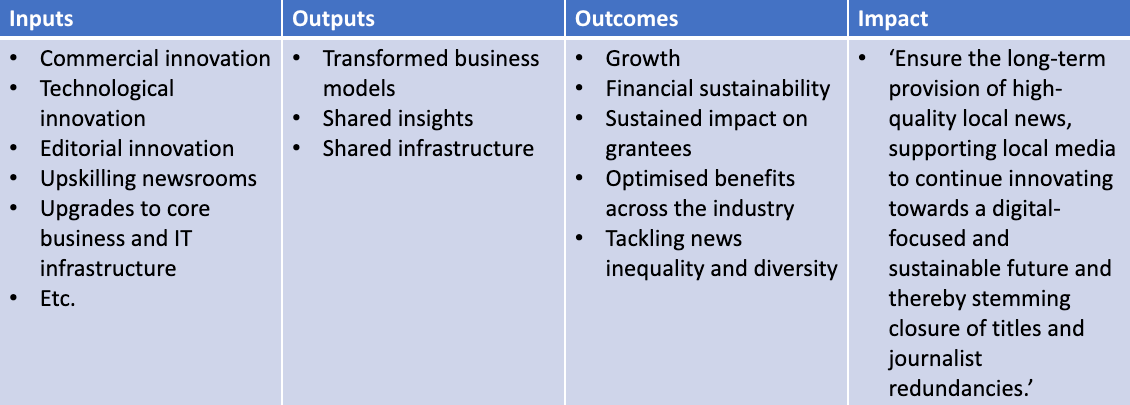
When we put together funding proposals at PINF, we always start from the end point and work backwards. It's standard practice in the grant world and we find it a really a useful way to structure your thinking for the best chance of winning your bid.
Start with the impact. DCMS's ultimate goal is the long-term provision of high-quality local news, rolling back the tide of title closures and job losses.
Then the outcomes. What change can you make to support that aim? The strongest bids will show a credible, sustained path to increased revenue, not a one-off spike, e.g. subscriptions or membership models with recurring income, rather than a single funding push.
Then the outputs. Working backwards again, what change in your business model or new efficiencies will bring about that outcome? It doesn't have to be a complete revolution!
Finally the inputs. What will you invest in to bring about sustainable change? Some examples are listed below - but it's not an exhaustive list.
Use it or lose it
This money is sitting on the table waiting to be claimed. We've spent years making the case that funds like this should exist. If it’s not claimed, it will be 100 times harder to ever secure this kind of Government funding again. Don't count yourselves out because the paperwork looks daunting or the timeline feels (and - admittedly - is) tight.
If you're a local news provider in England or Wales, start your bid now. PINF is looking at how we can support shared learning and infrastructure across the sector as part of this, including hosting regular check-in calls for the next month - so if you haven’t yet joined our Network of independent publishers, get in touch now!
Written by