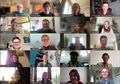
Lucas Batt, co-founder of Greater Community Media, shares how the first training on co-creational media is changing practice in newsrooms and building a global community of practitioners.
"I was very happy to get this group, because for a minute I thought I was crazy – nobody’s understanding me.”
Lynn Obwoge runs Rafiki Afrique, a Kenyan community media platform dedicated to telling African stories that drive social change. In early 2026 she joined the first Co-Creational Media Training Programme and finally found her people.
"Having found this community was really big – I've found a place where people are actually speaking the same language as we have tried to speak to so many people.”
Lynn is typical of a generation of journalists rethinking how journalism should be done, because the old models no longer work. They are centering the needs and voices of communities, treating them as active citizens rather than passive audiences, building genuine relationships, enabling participation and sharing power. But often they are finding there are very few other journalists or news organisations who understand what they’re doing.
Having spent a decade pioneering a lot of this practice through Greater Govanhill and the Bristol Cable, we set up Greater Community Media to help others do the same, and build sustainable community-centred projects and organisations.
The Co-Creational Media Toolkit offers a framework for that work, so it made a perfect match when we were invited to bring the Toolkit to life by translating it into practical training that journalists and newsroom leaders can use.
The first thing we learned was the scale of demand. We received 107 applications from journalists and media leaders in 29 countries across five continents – from established international non-profit newsrooms, to thriving community publishers across the UK, community radio in West Africa, and people setting up new community-centred media projects from Europe to Australia. They all recognise the importance of putting communities at the centre of their work, and most are doing it largely alone.
We selected as many as we could, from a broad range of contexts and experiences, to join our pilot training programme. 41 practitioners joined us across four separate sessions, and following the training, every single participant said they planned to change their practice as a result.
But the most valuable thing we provided, it turns out, wasn’t the training, but the room. In the feedback participants consistently described the huge value of just being together with others doing similar work, and sharing their experiences. The training’s impact was as much about ending isolation as it was about transferring knowledge, and the peer to peer exchange was core to that.
"Hearing other people talk about how they do co-creation and seeing the frameworks gave me understanding of how it works in the real world, and made me feel like it was possible." - Bex Bastable, a journalist who’s thinking about launching a new community-focused project
There is immense power in convening, and there is something obvious and beautiful about making training about co-creation itself co-creational. Each of the participants brought their own experiences and questions that they shared with each other, collectively revealing a map for others navigating the same questions. And by bringing them together, this created new connections, solidarity and a community that will outlast the sessions.
So it was no surprise to us that everyone who participated in the training wanted to be part of a co-creational media community of practice. They want it to be a place where they can continue to learn from each other and support one another, providing both inspiration on what works, and a safe space to share what didn’t.
One person said "there's something affirming about hearing from a global perspective that people are navigating the same types of challenges,” while another said "even just feeling like I'm checking in with a group of people – that in itself is motivating.”
We hosted our first meet-up a few weeks ago where we heard how they had been putting co-creational training into practice, including community reporter training in Sussex, and community governance design for a newsroom in Leeds.
In Nairobi, Lynn is convening Rafiki Afrik's first community gathering, bringing together young African founders, creatives and community members to co-design the platform's direction. “It's absolutely because of what we did, and how we learned, and how you're bringing journalists together to create, and amplify the voices of the people," she told us at our first community of practice meet-up.
This is what regenerating local news looks like in practice. It isn't only about rebuilding business models – though that matters too. It's about reimagining the relationship between the storytellers and the people those stories are about.
The journalists who participated in our training know that if local news is to be viable and genuinely valuable to communities, it needs to be fundamentally reorientated around them.
But there remain significant barriers to doing this work.
Co-creational journalism is often resource-intensive by design. Building meaningful community relationships takes time, as do developing revenue models that support this work. Often this work looks more like community development than simply journalism, and there are clear arguments to fund it for the community value it creates, but because the work cuts across social justice, health, education, and community there is a gap in funding for community-centred journalism.
There is significant potential to grow this practice, and funding is a big part of that. The training showed that despite the lack of funding for this work, people are not short of ideas or commitment to their communities, and are pioneering this work across the world.
We are committed to nurturing this community of community media practitioners. If you’re interested in joining future co-creational media training or the community of practice, sign up here. And if you’re a funder interested in supporting this work, we’d love to hear from you.
Greater Community Media is a non-profit dedicated to building infrastructure for community-centred journalism.
Written by