
PINF Campaign and Comms Manager, Beckie Shuker, digs into the details of LION's Sustainability Audit report to work out what we can learn from the US on local news sustainability in the UK.
What does it take to keep a local news outlet alive? It’s a question that we at PINF have been exploring for more than six years. As anyone paying attention to local news knows, a publication can seem strong and healthy one month and be gone in the next. Why?
LION (which stands for Local, Independent, Online News) Publishers, a non-profit professional association founded in 2012 to strengthen the local news industry in the United States, set out to find out.
Dozens of trusted, professional, committed outlets are closing suddenly every year. PINF’s most recent report found that at least 22 closed in the UK in 2025 alone.
Through conversations with local publishers in the US, LION found that many “had been building their businesses on the fly through necessity” and focussing on serving their communities and keeping the lights on, so had big gaps in their operations: no profit and loss statement, organisational documentation or operational strategy.
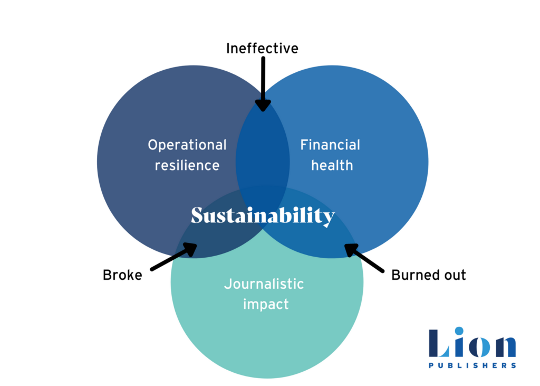
LION posited a theory that an accurate measure of sustainability when it comes to local news is made up of three factors:
- Operational resilience - the systems needed to support staff and actively manage growth.
- Financial health - proper budgeting, clear policies and revenue tracking.
- Journalistic impact - demonstrating a track record of meaningful community impact.
Gaps in any one of these pillars of sustainability can lead to burnout, financial collapse or a loss of public and funder support. Sustainability isn’t just about journalistic excellence or even reliable revenue, but the infrastructure required to run an organisation without burning out.
Building on this hypothesis, through a combination of qualitative interviews and quantitative survey questions, LION produced a data set to identify patterns across publications and produce insights for publishers to act on.
This led to the creation of a self-service Sustainability Audit tool that more than 350 LION members across the US have made use of since 2022. A mix of for-profit and not-for-profit organisations undertook the Audit, with a median revenue of $135,989 (about £100,687).
Nearly 300 incredibly comprehensive indicators are used to measure an organisation’s health:
- Operational resilience indicators include whether the organisation has a succession plan and 1-3 year plan, dedicated revenue staff, liability insurance, a payroll system and HR policies like flexible working, transparent salary ranges, equitable compensation and a DEI statement.
- Financial health indicators include whether the organisation has a budget, a balance sheet, an annual budgeting process, a bookkeeping process, annual revenue goals and a tracker for member interactions.
- Journalistic impact indicators include engaging in regular audience feedback, plus defining, tracking and using journalistic impact data in workflows.
At the end of 2025, LION published a report on their learnings so far, and the headline may not be surprising, but couldn’t be more important: organisations that carve out dedicated time to developing their infrastructure both earn more revenue and feel more sustainable.
Taking the time to step back and build a firm foundation from which to build is absolutely critical to long-term sustainability.
LION also emphasise that stable organisations had three or more established revenue streams - and having a staff member dedicated to generating revenue is a key measure of success.
LION encourages publishers to view their publication as a small business and create a plan to develop their organisation as early as possible. While the strength of the journalism attracts revenue, the health of the business underlying the endeavour will determine whether it lives or dies.
It’s an insight that feels timely for the UK’s local news sector, with an influx of funding due to land in the near future, and thus questions about how to spend it. Come back next week to hear about PINF's ideas for measuring the sustainability of local journalism in the UK.
Written by