As the mission to develop a UK Local News Fund continues, PINF’s deputy director, Joe Mitchell, is delighted to share some newly commissioned research on trailblazing news funds from around the world.
It’s time for a UK Local News Fund. PINF is moving full-steam-ahead on creating a fund that will help deliver our vision for the regeneration of local news in every community in the UK.
We’re not alone. News funders have sprung up all over the world in recent years. So last autumn, we commissioned Greater Community Media to research what works in other countries and how we could transfer those lessons to the UK.
Greater Community Media (GCM) has produced an immensely valuable piece of research that will guide PINF and a vanguard of UK funders through the process of building the Fund. And I imagine will guide plenty of people outside the UK too.
To produce the report, Lucas Batt from GCM spoke to people from ten news funds from Canada to Brazil and France to North Carolina — and reviewed all the documentation he could find on them. Those funds have collectively raised the equivalent of £560m to invest in the long-term revival of quality, sustainable local news.
Below I mention a few findings that stuck out for me, but for best results, I’d recommend reading the full-fat version of the report — or, if you only have ten minutes, the executive summary.
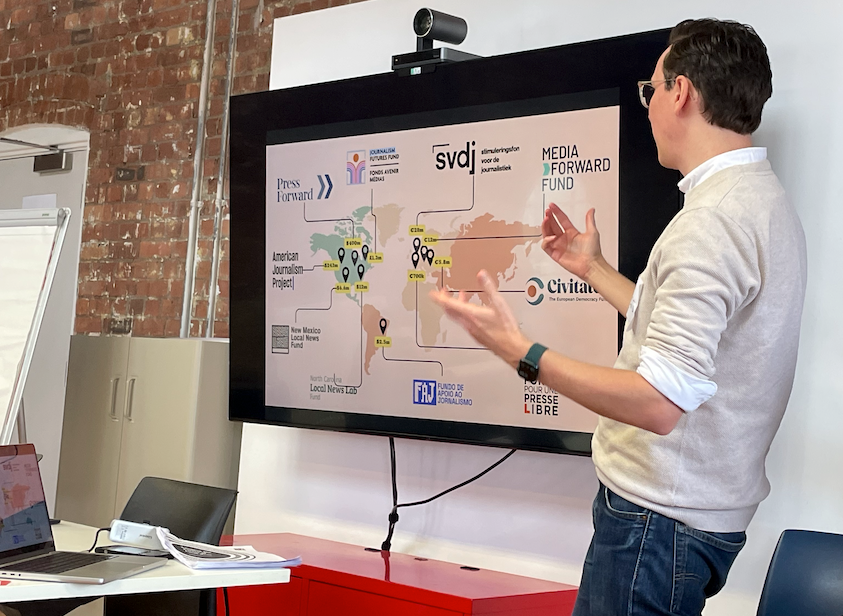
The case studies show diverse funders coming together to support local news by pooling resources into a single fund. They recognise that through a coordinated approach, and shared strategy, a journalism fund can have a meaningful impact on a challenge as serious as that faced by local news.
Each fund recognises that support for news is support to improve lives through community impact (better public understanding of local issues, better representation of community voices, better trust, better cohesion), economic impact (effective public services, stronger local businesses and high streets) and democratic impact (better scrutiny, more fact-based facilitated debate, better civic participation and voter turnout). Whatever issue or topic area you care about — from health to education to climate — news and information affect it.
Some funds are phenomenally successful — with one fund generating $3.80 in new sustainable local revenue for every $1 invested in the newsrooms they support. (PINF believes that there is sufficient room for growth in the UK for a similar story to be realised here.)
Funds are remarkably similar — the world is coalescing around evidence-based approaches that work: catalytic funding, coaching, peer learning, a focus on revenue development and a layer of infrastructure for tech, legal, talent, training and networking.
One fund can’t solve all the challenges to ensuring that all communities are served with quality local news. There will continue to be a need for good policymaking and legislating to incentivise public support and make big tech play fair. And there will be places of deprivation whereby efforts to grow revenue will be tough. There will be risks — some newsrooms will fail — and there will need to be patience as change emerges. But these examples of funders around the world are showing that real progress can be made towards the regeneration of local news.
The full report details the approaches to pooling funds, to decision-making and the importance of firewalls, the various theories of change, the different types of support for newsrooms, and it gives ten in-depth case studies of journalism funds to learn from.
We're very grateful to GCM for their hard work — and to the funders of our work to develop a UK Local News Fund, in particular Press Forward, Paul Hamlyn Foundation and Indigo Trust. This work will be invaluable in providing a headstart for the UK Local News Fund. Onwards!
You can join us live online to hear from Lucas and two funders featured in the report on Tuesday 17th March at 2pm UK time. Sign up below.


Written by