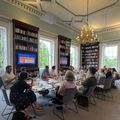
Campaign and Communications Manager Beckie Shuker reflects on our recent roundtable: 'The beating heart of our nation: toward a co-creational BBC'
What could a co-creational approach to news look like for the BBC? We put this question to a small group of expert stakeholders, from civil society, to journalists, to the BBC itself, at a roundtable in London on Tuesday.
Informed by interventions from Fabienne Peter (University of Warwick), Lucas Batt (Greater Community Media), Eliz Mizon (Freelance Journalism Consultant), Iain Bundred (BBC), Polly Curtis (Demos) and Jaldeep Katwala (Sir Lenny Henry Centre for Media Diversity), the roundtable was a chance to consider whether a public interest news organisation on the biggest scale could make use of the co-creational approach to help best serve the UK public.
Why now?
The government’s Green Paper on the Charter describes the BBC as ‘the beating heart of our nation’ and ‘a national institution that belongs to all of us’, stating that the Charter Review ‘must support and empower the BBC to continue to adapt and evolve’.
Over the last two years, a working group of academics and practitioners identified sixteen distinct elements of co-creational practice, set out in the Co-Creational News Media Toolkit and explored through trainings by Greater Community Media earlier this year.
The co-creational approach to news has gained significant interest in recent years because of its potential to build engagement, trust and loyalty, particularly among communities who feel badly served by other forms of media.
We wanted to know whether this group of experts thought the BBC could adopt a version of co-creation - either by fully embracing the model, incorporating a minimal or median version - or not at all!
Participation and truth
We opened the discussion by setting out the thinking behind the model: a healthy democracy depends not just on truth-seeking but on participation, with the two reinforcing each other. Populism trades on participation without truth, while traditional news orgs have often relied on truth-seeking without participation. Social media offers the highest degree of participation but lowest levels of truth. Co-creational news media tries to hold both together.
Trust is built by giving power away and keeping promises, not by better and shinier comms. Several examples brought this to life, from Bylines Network’s citizen journalism with editorial oversight to Greater Govanhill’s community reporter training.
Much of what co-creational practitioners do would once have simply been called journalism. The instinct to listen deeply to communities isn't necessarily new – it's what local reporting used to be, before changing business models made that function more and more difficult to do justice.
Motivation matters
The matter of motivation kept on coming up. Co-creating news media could help to solve a number of issues, from engaging with people who have switched off, to supporting a stronger media ecosystem, to addressing misinformation, to simply helping people deeply understand the world around them and create shared understandings in communities.
If the BBC's interest in co-creation is driven solely by fear of declining trust, that's a shakier foundation than if it's driven by a genuine desire to change. Some participants pointed to an unresolved identity crisis sitting underneath this: what does the BBC believe it's for in the 21st century?
The model matters
There were concerns about a deep transfer of power resulting in the loss of the BBC's commitment to impartiality and damage to its reputation if it were to be perceived as a campaigning organisation. However, should some editorial functions remain, or even strengthen, there's no need to choose between top-down or co-creational.
Power doesn't have to be shared equally to be shared meaningfully. The relationship between the BBC and the public isn't one between equals, but it can still be one of accountability.The opportunity lies in the BBC becoming more permeable, with a human face that shows up for local communities, perhaps physically through shared civic infrastructure like meeting space, studios and newsrooms.
Working in partnership with charities and local media could be a win-win way to maintain the commitment to professional standards and get to difficult places - like the ‘wilfully unaware’ identified in our recent report with Local Trust.
From principle to practice
Some potential mechanisms considered include accountability sessions where audiences meet the people making the journalism, Citizens' Agendas that ask the public what they want candidates asked, rather than letting politicians and editors set the terms of election coverage, and partnerships with organisations that are themselves already trusted within communities, rather than the BBC trying to build every relationship anew.
From where I was sitting, I believe our group of experts settled on a conclusion that if the BBC had the right motivation for going down this road and could align on the right model there are lots of opportunities to humanise the organisation, be more responsive to community engagement, and partner with organisations that are themselves co-creational. It might not be right for the BBC to launch straight into a 'full-fat' adoption of co-creation, but testing the water with a 'semi-skimmed' version might just go down nicely.
We're grateful to the Department of Philosophy at the University of Warwick for supporting the costs of this roundtable, and to PINF's core funders – including the Cobalt Trust, the Indigo Trust, the Joseph Rowntree Charitable Trust, Reset and the Tinsley Charitable Trust – for making this work possible. We'll keep sharing what we learn as the Charter Review process continues.
Written by